



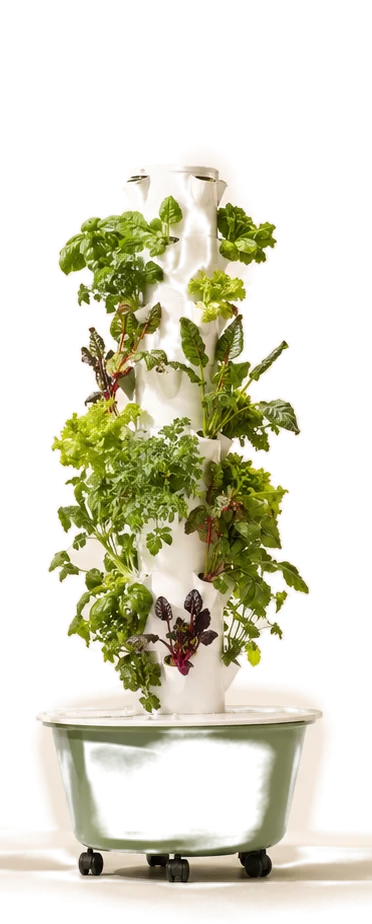


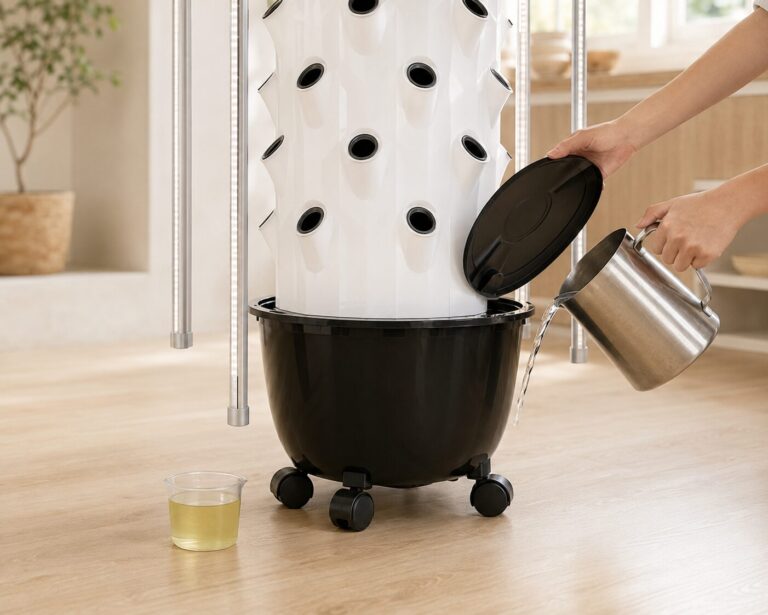

The quick answer
Suitable tap water can work well for hydroponics; reverse osmosis or distilled water is not automatically necessary. Test the source before adding nutrients, then check the mixed feed separately. Starting EC, pH, alkalinity, and the minerals present all matter. One universal “ppm target” cannot tell you whether every crop and water supply are a good match.123
Start With Your Water, Not a Filter
Clear water is not proof of suitable chemistry or microbiological safety. Begin with your utility’s report or a well-water test, then sample the water that actually reaches your garden. A new filter is useful only when it addresses an identified problem.210
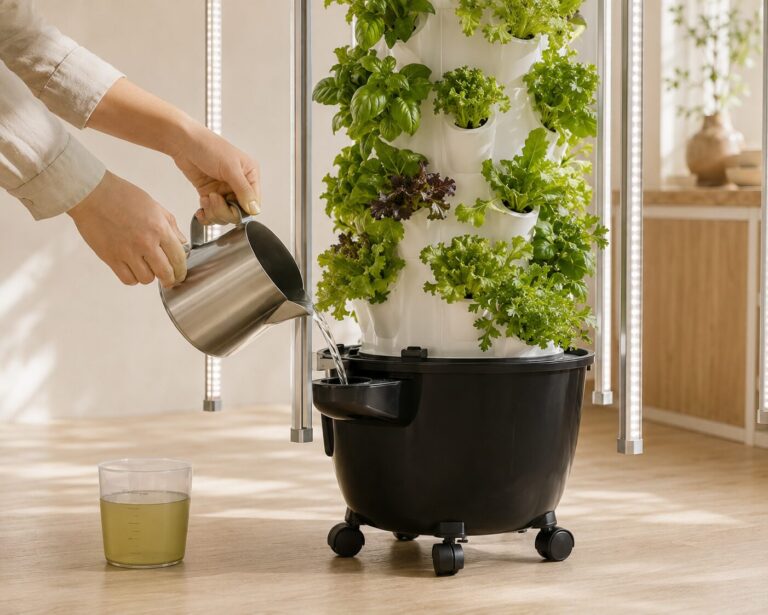
Four Checks Before You Fill
Separate the quality of your starting water from the strength of the finished feed. They answer different questions.4
Source. Test. Mix. Recheck.
Two samples. Two purposes.
Identify the source
Check the supplier, disinfectant, and any household softener. Investigate unknown or changing supplies before use.
Measure a baseline
Record source-water EC and pH. Add an alkalinity test; request mineral analysis when salts or scaling are a concern.
Choose, then mix
Use suitable water or treatment supported by the results. Add a complete nutrient program according to its label.
Check the mixed feed
Allow mixing, measure EC, then check pH. Record the final readings and use crop-specific feeding guidance.
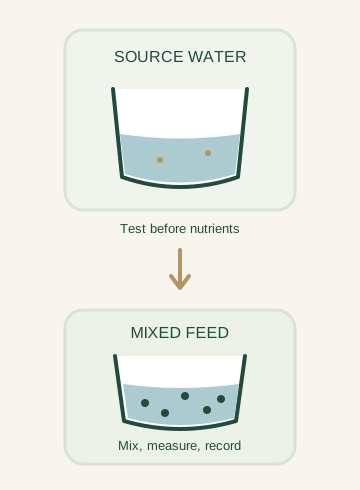
Use clean containers and follow nutrient, meter, and treatment instructions. Do not improvise concentrated-acid or disinfectant recipes.
Five Sources, Different Trade-Offs
Choose from evidence, not a blanket “best water” ranking.17810
Tap water
A practical option when its composition suits your feed. Check the actual supply rather than assuming all tap water is unsuitable.
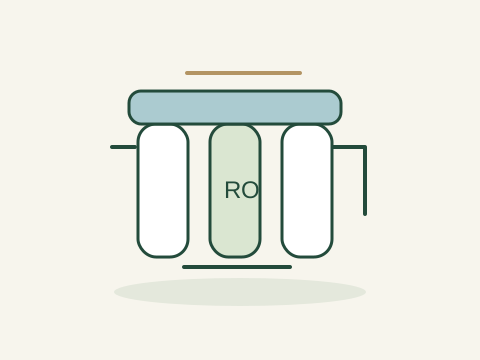
Reverse osmosis
Useful when dissolved salts complicate feeding. Allow for filter maintenance, output capacity, and reject water.
Distilled water
A low-mineral starting point for small volumes. It still needs complete nutrition; bottled-water cost and handling add up.
Well water
Test its chemistry and microbiological quality. Safety and mineral content cannot be established from taste or appearance.
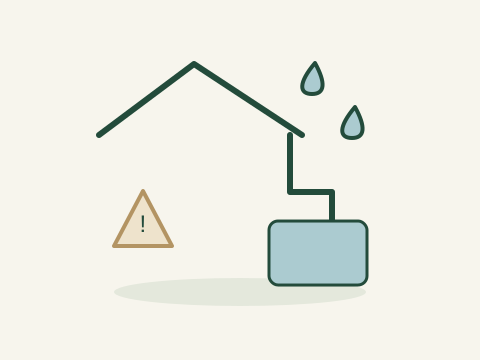
Collected rain
Roof collection can introduce germs and chemicals. For edible crops, prefer a safer known supply; a debris screen is not disinfection.
RO and distilled water may contain little calcium or magnesium. Check what your complete feed already supplies before adding supplements.9
Know What Each Test Tells You
These checks complement one another; none proves water is sterile.2910
pH
How acidic or basic the sample is now. It is not the same as alkalinity.
EC
Conductivity from dissolved ions. Record units; it is not a complete nutrient analysis.
Alkalinity
Resistance to acidification. It can help explain persistent upward pH drift.
Hardness
Mainly calcium and magnesium. These are nutrients, but their contribution affects the feed.
Keep Water Quality Consistent
A short record helps reveal changes.14
Watch the level
Check delivery and refill needs as plants grow; do not let the pump run dry.
Measure before feeding
After top-ups, mix and recheck before deciding whether more feed is needed.
Investigate changes
Unexpected drift or repeated scaling merits a source-water review, not repeated blind dosing.
Refresh and clean
Follow the system and nutrient program. Remove debris and keep unwanted light out of stored solution.
Fewer Assumptions, Better Decisions
Useful habits
- Test before buying treatment.
- Keep units and meter scales consistent.
- Choose a manageable care routine.
Avoid these shortcuts
- No universal 200–300 ppm feed target.
- Softened water is not RO water.
- Yellow leaves alone do not identify the cause.
Common Water Questions
Start with the measurement, then choose the next step.
Can I use tap water in hydroponics?
Often, yes. Check its starting chemistry and how it behaves with your chosen feed. Use a reliable supply; pursue treatment when testing identifies a problem rather than buying RO equipment automatically.12
Do I need reverse osmosis or distilled water?
Not necessarily. Low-mineral water can simplify some feed programs, but still needs complete nutrients. Choose it when your source-water results justify the extra cost, maintenance, or handling.79
Will leaving tap water overnight remove chloramine?
Do not rely on it. Chloramine persists much longer than free chlorine. Identify the disinfectant, then use a treatment with a verified claim for that substance when reduction is needed. Follow its rated flow and replacement instructions.56
Will a normal filter remove hardness?
Not necessarily. Sediment and ordinary carbon filters are not a blanket solution for dissolved minerals. Check the exact treatment claim. Sodium-exchange softened water can introduce unwanted sodium; do not assume it is suitable feed water.26
Put Your Water Plan to Work
View all guides →Choose a useful next step, not another version of the same answer.
Sources & editorial notes
Technical references support the guidance above. Filter performance, source-water chemistry, and feeding requirements vary. This is a growing guide—not a water-safety certification or a model-specific dosing recipe.
- University of Minnesota Extension: Small-scale hydroponics
- Penn State Extension: Interpreting Irrigation Water Tests
- Bluelab — instrument manufacturer: What are the different conductivity scales?
- Oklahoma State University Extension: Electrical Conductivity and pH Guide for Hydroponics
- U.S. Environmental Protection Agency: Chloramine — Region 9 archive
- NSF: Contaminant Reduction Claims Guide
- U.S. Environmental Protection Agency: Point-of-Use Reverse Osmosis Systems
- Centers for Disease Control and Prevention: Collecting Rainwater and Your Health
- Penn State Extension: Water Testing
- Centers for Disease Control and Prevention: Agricultural Water and Your Safety